The TRACE Board of Directors

Director, President
Dr. Sally Dickinson
Dr. Sally Dickinson has dedicated her life to training, handling, and coaching search and rescue (SAR) dog teams worldwide. Alongside her 20-year career as a firefighter/paramedic and technical rescue specialist, she has trained and deployed SAR dogs at local, national, and international levels. She focuses on teaching SAR canine programs that integrate operational experience with evidence-based training, aiming to enhance the behavior of both handlers and dogs, ensuring they perform exceptionally under real-world conditions.
Sally holds certifications from the KPA Professional Dog Trainer program, the University of Tennessee’s Canine Fitness Trainer program, and the University of Washington’s Animal Behavior program, in addition to a PhD in Applied Animal Behavior from Virginia Tech. Her research and future work focus on the intersection of welfare and performance of SAR and conservation detection dogs.
Sally is dedicated to improving SAR dog training through science-based, practical instruction that helps handlers and dogs excel in mission-ready deployments.
Director, Secretary-Treasurer
Jerald "Scott" Rainey
Scott’s life-long passions are dogs and the sea. Scott worked as kennel staff at a veterinary practice while in high school. He earned his bachelor’s degree in management from the Coast Guard Academy. While on active duty, Scott served as the navigator for the icebreaker Polar Star, sailing to the Arctic and Antarctic. After icebreaking, Scott was selected to command the patrol boat Point Countess and conducted search and rescue and law enforcement missions, saving several lives at sea in the Pacific Northwest and seizing two large drug shipments, after he captained his ship to its new homeport in Florida. Scott completed the National Search and Rescue School and then returned to Seattle to serve as a Rescue Coordination Center Controller, planning and directing search and rescue missions throughout the Pacific Northwest. After his active-duty service, Scott earned his merchant marine captain’s license and worked on large fishing vessels and coastal freighters that sailed between Seattle and various Alaskan ports.
After graduating law school at the University of Washington, Scott served as counsel to the Merchant Marine and Fisheries Committee in Congress and then represented various maritime industry associations. Scott returned to federal service with the National Transportation Safety Board. Prior to retiring, Scott was awarded the NTSB's Public Service Award for his work on safety recommendations and his contributions to pipeline and major marine accidents investigations, including the ship strike and collapse of the Francis Scott Key Bridge and the Titan submersible implosion.
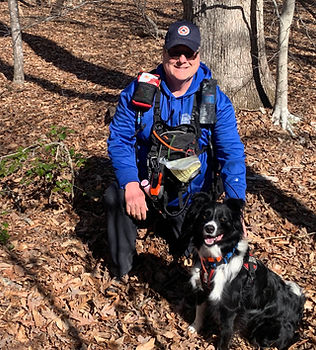
Scott has owned many different dog breeds, including numerous rescues and two AKC-registered Newfoundlands. Scott has trained his dogs in obedience, rally, tracking, draft (carting), and water rescue. Scott chaired the Colonial Newfoundland Club’s annual water rescue trials for several years. Scott’s newfs were also show dogs. His dog, Winslow, won the working group and competed for Best in Show at the National Dog Show, which was televised on Thanksgiving Day 2015. Scott and his border collie Echo are a wilderness live find K9 unit with the Virginia Search and Rescue Dog Association.
Director
Dr. Erica Feuerbacher
Dr. Erica Feuerbacher is a Professor in the School of Animal Sciences at Virginia Tech and director of the Applied Animal Behavior & Welfare Lab, where she focuses her research on dogs and horses. She is also coordinator for the Applied Animal Behavior & Welfare concentration for the Online Masters in Agriculture and Life Sciences at Virginia Tech.
She earned her Ph.D. in Psychology at the University of Florida in the UF Canine Cognition and Behavior Lab and her Master’s in Behavior Analysis at the University of North Texas in the Organization for Reinforcement Contingencies with Animals. She is a Certified Applied Animal Behaviorist and a Board-Certified Behavior Analyst.
Her research focuses on understanding domestic animal behavior and learning from a behavior analytic perspective, using applied animal behavior to solve behavioral issues in dogs and horses, and identifying interventions that improve shelter dog welfare. She has published her research in a variety of scientific journals and has won awards for her research and teaching. She is passionate about humane, effective animal training and working with owners, trainers, and shelter staff to improve our interactions with animals.
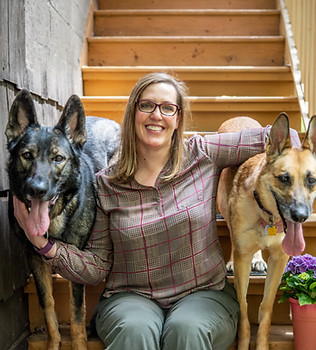
She currently shares her life with her German Shepherd, Webjørn, Belgian Malinois, Leica, Aussie/bulldog x, Wishy B, her clicker-trained horse, Magic, four cats, and an assortment of barnyard animals.
Director
Natalie Runge, MA
Natalie Runge, MA, LPCC, C-AAIS, is a licensed professional clinical counselor, certified animal-assisted intervention specialist, and working dog professional with expertise in search and rescue, detection, working dog conditioning, animal-assisted interventions, and human-animal interaction. Natalie trains and deploys certified live find and human remains detection search and rescue dogs in wilderness and disaster environments.
She earned her Master of Arts in Counseling Psychology from the University of St. Thomas. She holds graduate certificates as a Canine-Assisted Intervention Specialist and Animals and Human Health from the University of Denver's Institute for Human-Animal Connection. She also earned the Penn Vet Working Dog Practitioner Certificate, furthering her expertise in working dog conditioning, performance, and health. She is currently pursuing a Master of Science in Applied Animal Behavior and Welfare at Virginia Tech. Natalie has co-authored book chapters on equine-assisted psychotherapy and contributed to published competency frameworks for human-animal-assisted interventions and services. She is passionate about advancing ethical, evidence-informed practices that support the welfare and performance of working animals and the people who partner with them.
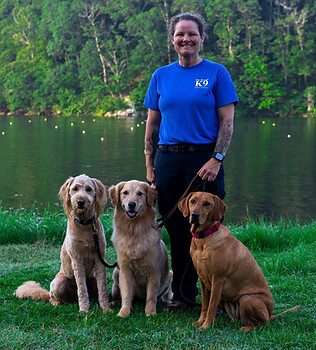
She shares her life with a therapy herd of horses and mini donkeys and her search and rescue dogs, Oliver, Cali, and Everest, with Cali also serving as a Critical Incident Response Canine.
.jpg)
Director
Dr. Joe Dizino
Joseph A. DiZinno, DDS received a Bachelor of Science (B.S.) Degree from the
University of Notre Dame and a Doctor of Dental Surgery (D.D.S.) degree from Ohio State University. After practicing dentistry for approximately six years, Dr. DiZinno sold his dental practice to follow his childhood dream and entered onto duty with the FBI.
Dr. DiZinno trained as an FBI Special Agent and was assigned to the FBI Washington Field Office where he investigated cases mainly dealing with bank robberies, kidnappings and extortions. After three years as a field agent, he was assigned to the FBI Laboratory and qualified as a Forensic Examiner where he examined forensic evidence and testified to the results of his examinations.
Dr. DiZinno then spent approximately four years participating in forensic mitochondrial DNA (mtDNA) research and validation. He was then selected for several management positions in the FBI Laboratory and finally as the FBI Assistant Director in charge of the entire FBI Laboratory. Dr. DiZinno led all FBI Laboratory case working, forensic response and administrative personnel for approximately two years before retiring from the FBI in 2008.
Dr. DiZinno now serves as a faculty member at George Mason University where he teaches undergraduate and graduate level forensic science courses and continues to be involved with ongoing forensic research efforts as the Mason Forensic Program Graduate Research Coordinator.